
Is Grass-Fed Tallow Actually Effective for Skin?
Table of Contents
- What Grass-Fed Tallow Is and Why It's Used on Skin
- The Evidence: Is Grass-Fed Tallow Actually Effective?
- Benefits of Tallow for Aging Skin
- Does Beef Tallow Clog Pores?
- How to Use Tallow Balm on Face
- Grass-Fed vs. Conventional Tallow for Skin
- Risks, Patch Testing, and Who Should Skip It
- Conclusion
- Frequently Asked Questions
Last Updated: October 20, 2026
What Grass-Fed Tallow Is and Why It's Used on Skin
Grass-fed tallow is rendered beef fat from cattle raised on pasture, and it's used on skin because its fatty acid profile closely mirrors the lipids found in the human skin barrier.

Why does that matter? Your skin barrier is built from ceramides, cholesterol, and fatty acids. Tallow supplies saturated and monounsaturated fats, including oleic acid and stearic acid, that sit on the surface and slow water loss. That occlusive and emollient action is the entire mechanism.
Here's the honest framing most guides skip: tallow is an excellent moisturizer and a poor candidate for anything requiring clinical proof. We'll separate those two claims carefully below.
The Evidence: Is Grass-Fed Tallow Actually Effective?
Is grass-fed tallow actually effective? For moisturizing dry skin, yes, and the reasoning is straightforward: it is an occlusive fat that reduces transepidermal water loss. For treating acne, erasing wrinkles, or outperforming dermatologist-recommended ingredients, the evidence is thin to nonexistent. The useful answer is not a single yes or no; it is a tiered one, because the quality of evidence behind each claim is wildly different.
Sorting the Evidence Into Tiers
Most coverage of tallow collapses every claim into one bucket. That is the mistake. Here is how the evidence actually stacks up, from strongest to weakest:
Tier 1, Established mechanism (high confidence). Occlusive ingredients reduce water loss by forming a film on the skin surface. This is well described in dermatology and is the same mechanism behind petrolatum, lanolin, and mineral oil. Tallow is a fat, so it belongs to this functional family. The American Academy of Dermatology's guidance on moisturizers explains how occlusives trap water in the skin, and the National Eczema Association's skin barrier overview describes how barrier lipids deplete in dry and eczematous skin, exactly the gap a fat-based balm fills. This tier supports the moisturizing claim.
Tier 2, Indirect or ingredient-theory evidence (moderate confidence). Tallow contains oleic acid, stearic acid, and other fatty acids, plus small amounts of vitamins A, D, E, and K.
Tier 3, Anecdotal and testimonial (low confidence). Personal reports of clearer skin or softer lines are common online. They are also uncontrolled: no baseline, no comparison group, no blinding, and often a routine that changed several products at once.
Tier 4, No direct evidence (claim unsupported). There is no peer-reviewed controlled trial on tallow as an acne treatment, no trial on tallow as an anti-aging ingredient, and no head-to-head study pitting tallow against ceramides, retinoids, or benzoyl peroxide.
What the Research Shows (and What It Doesn't)
What the research shows is largely indirect. The occlusive mechanism is real and well documented for other fats; the barrier-repair story is real for ceramides and cholesterol. What the research does not show is any controlled trial on tallow itself. That distinction, mechanism versus direct trial, is the single most useful thing to carry into any tallow claim you read.
How to Read a Tallow Claim
When you see a bold claim, run it through three questions:
- Is the evidence about tallow, or about a similar fat? If it is about petrolatum or lanolin, it supports the mechanism, not the specific product.
- Is it a human trial or a lab study? Lab studies on fatty acids in a dish do not translate directly to skin on a face.
- Is the outcome measured or reported? 'Users say' is not a measurement. 'Transepidermal water loss decreased' is.
That framing is what separates a useful guide from marketing copy, and it is the honest answer to whether grass-fed tallow is actually effective.
Benefits of Tallow for Aging Skin
Aging skin loses lipids and moisture faster than younger skin, so the benefits of tallow for aging skin come down to sustained hydration rather than collagen stimulation.
Where it falls short: no topical fat rebuilds collagen or reverses fine lines. Vitamin A in tallow is present in trace amounts, nowhere near the concentration of a formulated retinoid. If wrinkles are your priority, tallow is a supportive layer, not the active ingredient.
A common mistake is expecting a balm to do a serum's job. Use tallow for comfort and barrier support, and keep proven actives in your routine.
Does Beef Tallow Clog Pores?
Does beef tallow clog pores? It can, for some people, because tallow is rich in oleic acid, which is more comedogenic than linoleic acid. Oily and acne-prone skin tends to tolerate high-oleic products poorly.
That doesn't make tallow universally pore-clogging. Comedogenicity depends on concentration, your skin type, and how much you apply. A thin layer on dry cheeks behaves differently from a heavy layer on an oily T-zone.
Our practical rule: if you are acne-prone, patch test on the jawline for a week before going near your full face. The FDA's consumer guidance on cosmetic safety and adverse reactions is worth reading on how to report a reaction and what "cosmetic" legally means.
How to Use Tallow Balm on Face
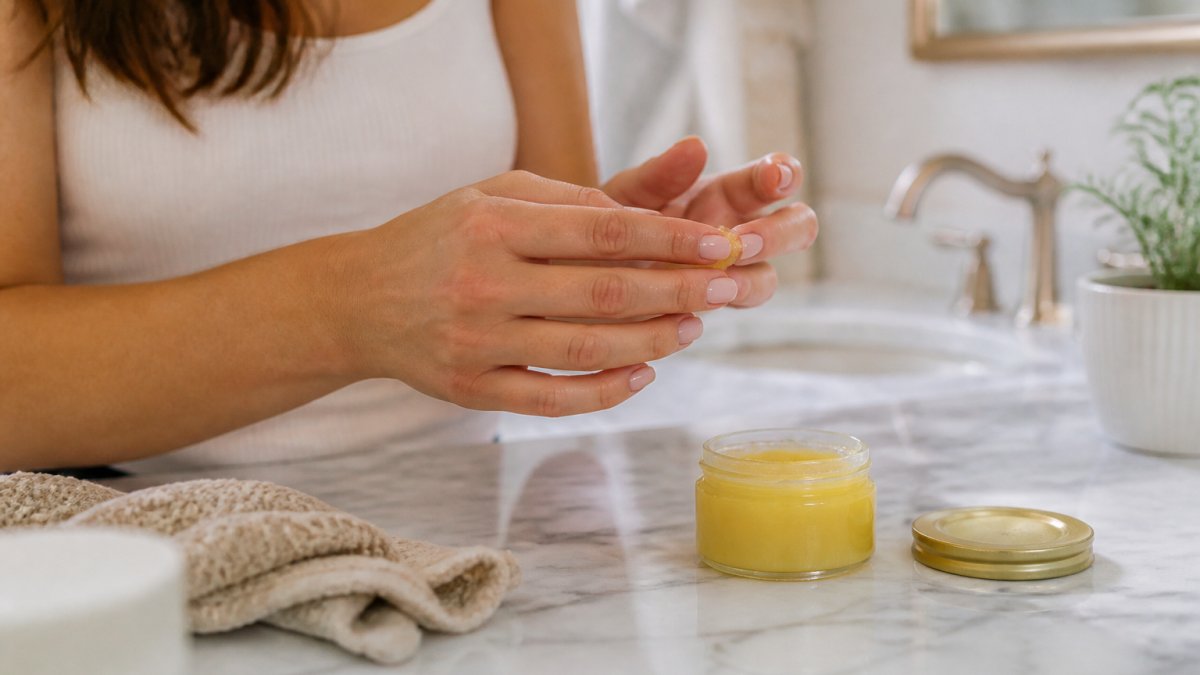
Use tallow balm on face as the last step of your evening routine, on slightly damp skin, in a thin layer.
Grass-Fed Tallow Balm for Dry Skin →

A simple protocol:
- Cleanse and pat skin until barely damp.
- Warm a pea-sized amount between fingertips.
- Press into dry areas first, then spread the remainder.
- Start with three nights a week, then build up.
- Patch test on the inner forearm for 48 hours before first facial use.
Our Grass-Fed Tallow Balm for Dry Skin is built for exactly this: four ingredients, a light sweet orange scent, and enough slip to cover hands, elbows, and heels too.
Grass-Fed vs. Conventional Tallow for Skin
The grass-fed vs. conventional tallow for skin question is really two questions tangled together: does the animal's diet change the fat in a way that matters for skin, and can you verify the sourcing claim on the label? The first is mostly unstudied; the second is where the real differences live.
What Actually Differs Between the Two
Both grass-fed and conventional tallow are rendered beef fat with broadly similar fatty acid composition, mostly saturated and monounsaturated fats, with oleic and stearic acid prominent. The diet does shift the details: pasture-raised cattle tend to produce fat with a more yellow color and a somewhat different nutrient profile, while grain-finished cattle produce whiter, firmer fat.
So the honest position is this: grass-fed sourcing is a values and transparency choice more than a proven efficacy upgrade. If you care about how the animal was raised, grass-fed and finished matters. If you are choosing purely on measured skin benefit, the evidence does not yet separate the two.
Reading the Sourcing Claims
Labels are where the grass-fed question gets decided in practice, because the terms are not interchangeable:
- 'Grass-fed' alone can mean the animal had pasture access at some point. It does not guarantee the animal was finished on grass.
- 'Grass-fed and finished' is the phrase that tells you the animal was pasture-raised to slaughter. Look for it on the label, not just the marketing copy.
- 'Organic' is a separate certification and does not imply grass-fed. A product can be one, both, or neither.
- 'Pasture-raised' is a marketing term without a single legal definition; treat it as a claim to verify, not a guarantee.
What to Check on an Actual Label
A short, verifiable checklist beats a long ingredient story:
- The words 'grass-fed and finished,' not just 'grass-fed'
- A short ingredient list with no added fragrance blends
- Whether 'organic' appears only where a certification backs it
- A named rendering or sourcing statement, not just a farm photo
- No drug-like claims ('treats acne,' 'repairs wrinkles') on a cosmetic label
That last point matters legally as well as practically: a cosmetic is defined by its intended use, and claims that cross into treatment territory change how a product is regulated. The FDA's consumer guidance on cosmetic safety and adverse reactions is worth reading on what 'cosmetic' legally means and how to report a reaction.
The Bottom Line on Sourcing
Choose grass-fed and finished if the sourcing story matters to you and you can verify it on the label. Do not expect the grass-fed label alone to make the balm more effective on your skin, the evidence does not support that leap, and the label is doing a different job than the fatty acids are.
Risks, Patch Testing, and Who Should Skip It
Risks beyond simple irritation are real but narrow. Tallow is an animal-derived product, so anyone with a genuine beef allergy should avoid it. Essential oils, like the sweet orange in our balm, are a more common trigger than the tallow itself.
Who should skip it: people with active cystic acne, anyone with a diagnosed beef allergy, and babies under a few months old without a pediatrician's sign-off.
A patch-testing protocol that works:
- Apply a small amount to the inner forearm
- Leave uncovered for 48 hours
- Check for redness, itching, or bumps
- Repeat on the jawline for three nights
- Introduce to the full face only after both pass
Our Whipped Tallow Balm is the lighter-textured option if the classic balm feels heavy, and our Tallow Sunscreen pairs non-nano zinc oxide with the same grass-fed base for reef-friendly daily protection.

Conclusion
The honest answer is that grass-fed tallow is a genuinely good moisturizer and an unproven treatment for acne and wrinkles. If you want barrier support, deep hydration, and a short ingredient list you can actually read, it earns its place on the shelf.
That is exactly how we build at Palm Beach Tallow: grass-fed and finished tallow, organic olive oil, beeswax, and nothing pretending to be a drug. Start with a patch test, start small, and see how your skin responds. Add to cart when you're ready to try the balm on your own dry patches.
Frequently Asked Questions
Is grass-fed tallow actually effective for skin?
Grass-fed tallow is effective as a moisturizer. Its fatty acid profile, mainly saturated and monounsaturated fats, forms an occlusive layer that slows water loss from the skin, which is why people with dry or sensitive skin often notice softer, calmer skin within days. What it is not is a proven treatment for acne, wrinkles, or eczema. Those claims rest on anecdotal reports and the nutrient content of tallow, not on clinical trials. Treat it as a rich, simple moisturizer and you will have realistic expectations.
Does beef tallow clog pores?
Beef tallow can clog pores for some people. Its oleic acid content is higher than lighter oils, and oleic acid is linked to a heavier feel and more congestion on oily or acne-prone skin. That does not mean it clogs everyone's pores. Many people with dry skin use tallow balm daily without breakouts. If your skin is oily or you are prone to comedones, patch test on your jawline for a week before applying it to your full face.
How long does it take to see results from tallow skincare?
Most people notice softer, less tight skin within three to seven days of daily use, because the occlusive layer reduces water loss quickly. Improvements in flaking or rough patches usually show up in one to two weeks. Fine lines and texture take longer, and tallow will not erase them. If you see no change after two weeks of consistent use, or if you break out, stop using it. Skin that reacts badly rarely improves with more time.
Is grass-fed tallow better for skin than regular tallow?
The difference is in sourcing and purity, not in a proven skin outcome. Grass-fed and grass-finished tallow comes from cattle raised on pasture, and the fat is typically rendered in smaller batches with fewer processing steps. Conventional tallow may come from grain-fed cattle and be highly refined. Both moisturize. If you care about animal welfare, labeling transparency, and a shorter ingredient list, grass-fed tallow is the better match, and you can look for a stated source on the label.