
Benefits of Tallow for Aging Skin: What It Can (and Can't) Do
Table of Contents
- Why Tallow Works With Aging Skin, Not Against It
- Nutrients in Beef Tallow for Skin: Vitamins A, D, E, and K
- Tallow vs Retinol for Wrinkles: Two Different Jobs
- How to Use Tallow for Face: A Simple Routine That Fits Real Life
- Application Techniques for Mature Skin (What Most Guides Skip)
- Who Should Be Careful: Dermatological Conditions and Comedogenic Risk
- Long-Term vs Short-Term Results: Setting Honest Expectations
- Conclusion
- Frequently Asked Questions
Last Updated: September 11, 2026
Why Tallow Works With Aging Skin, Not Against It
The benefits of tallow for aging skin start with a simple fact: your skin recognizes it. According to Cleveland Clinic's overview of skin barrier function, a healthy skin barrier depends on lipids that closely resemble the fats found in human sebum. Tallow is rendered beef fat, and its fatty acid profile is remarkably similar to the oils your skin already produces. At Palm Beach Tallow, that biological match is the entire reason we build our formulas around grass-fed, finished tallow rather than synthetic emollients.
Aging changes the equation. As we get older, sebum production drops, the skin barrier thins, and transepidermal water loss climbs (peer-reviewed research). The result is the familiar trio: dryness, fine lines, and a dull, tight feeling by mid-afternoon.
Tallow addresses that decline at the source. Because its lipids mirror your own, it absorbs without sitting on top of the skin like a plastic film, and it delivers fat-soluble vitamins your skin can actually use. We'll cover what those vitamins do, how tallow compares to retinol, and exactly how to work it into a routine.
Nutrients in Beef Tallow for Skin: Vitamins A, D, E, and K
Beef tallow is one of the few skincare ingredients that arrives with its own vitamin complex intact. The nutrients in beef tallow for skin include vitamins A, D, E, and K, all fat-soluble and all delivered in a form skin can absorb because they come packaged in fat.
Here's what each one contributes:
- Vitamin A supports normal skin cell turnover, the process that slows with age and leaves dead cells sitting on the surface.
- Vitamin D plays a role in skin cell repair and supports the barrier's ability to defend itself.
- Vitamin E is an antioxidant that helps protect against free radicals, the unstable molecules that accelerate visible aging.
- Vitamin K is associated with skin tone and the appearance of discoloration.
The catch most guides skip: vitamin content varies enormously with the animal's diet and how the fat is rendered. Tallow from grass-fed, grass-finished cattle raised on pasture carries a richer nutrient profile than fat from grain-fed feedlot animals. If a label doesn't say grass-fed and finished, you don't know what you're getting.
Tallow vs Retinol for Wrinkles: Two Different Jobs
Tallow and retinol are not competitors. They solve different problems, and the tallow vs retinol for wrinkles comparison gets clearer once you separate them by mechanism rather than by marketing claim.
Retinol is a vitamin A derivative. It binds to retinoid receptors in skin cells, accelerates cell turnover, and signals fibroblasts to produce more collagen. That is a corrective, structural action, and it is why retinol has decades of clinical backing for softening fine lines. It is also why it irritates: the same accelerated turnover that remodels collagen thins the outer layer, causes peeling, and increases sun sensitivity, especially in mature or reactive skin.
Tallow works through a completely different pathway. It is an emollient and occlusive: its fatty acids fill the gaps between corneocytes in the stratum corneum, and its lipid film slows transepidermal water loss. It does not bind retinoid receptors. It does not stimulate collagen. What it does is restore the lipid environment that retinol needs in order to be tolerated.
That distinction matters because most people quit retinol during the peeling phase, not because it failed. A common pattern is a 'retinoid sandwich': a thin layer of tallow, then retinol, then a second thin layer of tallow. The occlusive layer reduces water loss and buffers the irritation spike without blocking retinol's action, because retinol is fat-soluble and passes through the lipid film.
If you are layering both, the practical order is:
- Cleanse and wait until skin is fully dry. Retinol on damp skin drives penetration and irritation.
- Apply a pea-sized amount of tallow first if your skin is reactive, or skip this step if your skin tolerates retinol well.
- Apply retinol at the concentration you already tolerate. Do not increase strength in the same week you add tallow.
- Seal with tallow on top. This is the step that most reduces flaking.
- Alternate nights for the first two weeks if you are new to either product.
The same logic applies to vitamin C. L-ascorbic acid is water-soluble and works best on clean, dry skin at a low pH, so it goes on before tallow, not after. Tallow applied over vitamin C will not neutralize it, but it will slow absorption if applied first. The rule of thumb: water-based actives first, oil-based occlusives last.
What tallow will not do is replace retinol. If your goal is collagen remodeling and wrinkle reversal, tallow is the support act, not the headliner. Expecting a moisturizer to do a retinoid's job is the most common disappointment in this category.
How to Use Tallow for Face: A Simple Routine That Fits Real Life
Learning how to use tallow for face takes about a week to dial in. The method is simple, but the amount matters more than most people expect.
Start with a clean, slightly damp face. Tallow is occlusive, which means it seals in moisture rather than adding it, so applying it to damp skin traps water where you want it.
- Morning: a pea-sized amount, warmed between fingertips, pressed into the face and neck. Follow with sunscreen.
- Evening: a slightly larger amount after cleansing. This is when tallow earns its keep, working overnight while skin repairs.
- Extra dry patches: spot-treat cheeks, around the eyes, and the jawline, the areas that show dehydration first.
A common mistake is using too much. Tallow is rich, and a heavy hand leaves a greasy film that never absorbs. Start small and add more only where skin still feels tight.
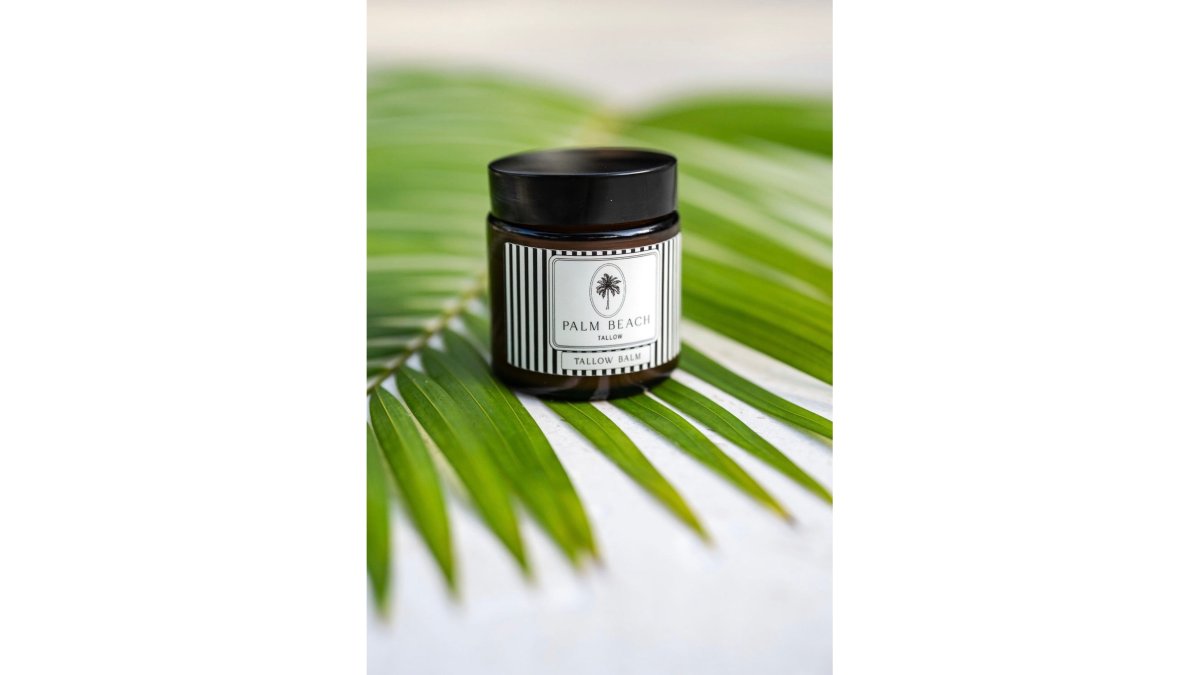
Palm Beach Tallow's Tallow Balm is built for exactly this routine: grass-fed and finished tallow blended with organic olive oil, beeswax, and a few drops of organic essential oil. For those who prefer a lighter texture, the Whipped Tallow Balm applies more like a body lotion and works well under makeup.


Application Techniques for Mature Skin (What Most Guides Skip)
Mature skin needs a different hand than younger skin, and this is where most tallow advice falls short. Thinner skin tears more easily, absorbs more slowly, and reacts to friction.
Press, don't rub. Warm the balm between your palms first, then press it into the skin with flat hands. Rubbing drags on fragile skin and can cause redness.
Layer by zone. Mature skin is rarely uniformly dry. The forehead may be balanced while cheeks and jaw are parched. Apply tallow only where skin needs it, and keep the T-zone lighter.
Apply to damp skin, always. This single habit makes more difference than any product swap. Tallow seals in water; it can't create it.
Give it two weeks. Barrier repair is not instant. Most people notice softer skin within days, but deeper changes in skin hydration take consistent use.
Who Should Be Careful: Dermatological Conditions and Comedogenic Risk
Tallow is not right for every face, and honesty here matters more than promotion. The interaction between tallow and common dermatological conditions in aging skin is the part most guides skip, so it is worth walking through condition by condition.
First, the comedogenic question. Beef tallow is high in oleic acid, a monounsaturated fat that ranks higher on the comedogenic scale than the linoleic acid that acne-prone skin tends to lack. Sebum in acne-prone skin is oleic-dominant, and adding more oleic acid can feed the same follicular environment that produces clogged pores. That does not make tallow universally comedogenic, but it does mean acne-prone skin should treat it as a patch-test-first ingredient, not a default moisturizer.
Rosacea. Aging skin with rosacea has a compromised barrier and heightened vascular reactivity. Tallow's occlusive film can reduce the water loss that triggers flushing. The risk is heat retention: a heavy layer on a flushed face can feel like it is trapping warmth. Introduce tallow on one cheek only, at night, for a week. If flushing episodes increase, stop. If they decrease, you have your answer.
Eczema. Between flares, tallow's lipid profile is a reasonable emollient for the dry, cracked skin that follows a flare. During an active flare, the skin is inflamed and often colonized with staph, and occlusive balms can trap bacteria and worsen the situation. The standard guidance is to use prescription treatment during a flare and reserve tallow for the maintenance phase afterward. If you have a known beef allergy, avoid tallow entirely.
Psoriasis. Plaque psoriasis involves rapid keratinocyte turnover and thick scaling. Tallow can soften scale and reduce cracking, which improves comfort, but it will not slow the underlying turnover. Use it as a comfort layer, not a treatment, and never apply it over a prescription topical without checking the order with your dermatologist.
Perioral dermatitis and seborrheic dermatitis. Both are conditions where occlusive, oil-rich products are commonly reported to worsen symptoms. If you have either, tallow is a poor first experiment.
Mature skin with none of the above. The main risk is simply over-application. Thinner, slower-absorbing mature skin can develop milia or congestion from a heavy hand, especially around the eyes and along the jawline.
A practical protocol for any of these conditions:
- Patch test on the inner forearm for three nights before the face.
- Then test on the jawline for one week.
- Then expand to the full face, one zone at a time.
- Stop immediately if you see new pustules, spreading redness, or increased flushing.
For children and babies, tallow's simple ingredient list is often the appeal, but check with a pediatrician before using any new product on an infant's skin. The American Academy of Dermatology's guidance on patch testing recommends testing any new product on a small area for several days before wider use.
Long-Term vs Short-Term Results: Setting Honest Expectations
Short-term, tallow delivers fast. Within days, many people notice less tightness, softer texture, and a calmer look to dry patches. That's the barrier doing its job.
Long-term results are subtler and slower. Consistent use over months supports skin integrity, meaning the barrier holds moisture better on its own and skin looks less reactive to weather and dry indoor air. What tallow will not do is erase deep wrinkles or lift sagging skin. No moisturizer does that.
The honest framing: tallow is excellent maintenance. It slows the visible effects of a declining barrier. It supports the skin environment where collagen and elasticity are preserved. It is not a corrective treatment, and any brand claiming otherwise is overselling.
Conclusion
Aging skin loses lipids faster than it replaces them, and that loss drives most of what we see in the mirror: dryness, fine lines, dullness. Tallow for aging skin works because it refills that lipid reservoir with fats your skin already recognizes, plus fat-soluble vitamins A, D, E, and K that support skin cell regeneration and defend against free radicals.
Frequently Asked Questions
Is tallow better than retinol for wrinkles?
They do different jobs. Retinol is backed by decades of research for increasing cell turnover and stimulating collagen, which softens fine lines over months. Tallow is a rich moisturizer and emollient that supports the skin barrier and reduces transepidermal water loss, so skin looks plumper and less creased. Many people use both: retinol at night, tallow balm on top to offset the dryness retinol causes.
How long does it take for beef tallow to work on wrinkles?
Hydration changes show up fast. Most people notice softer, less tight-feeling skin within a week of daily use, because tallow's occlusive and emollient properties slow water loss. Structural changes to fine lines take longer and depend on your full routine, sun protection, sleep, and genetics. Treat tallow as barrier support, not a wrinkle eraser, and give it four to eight weeks before judging results.
Why do some dermatologists express caution regarding tallow skincare?
Three reasons come up. First, tallow is heavy and occlusive, so acne-prone or oily skin may clog. Second, the marketing often outruns the evidence: there is no large clinical trial showing tallow reverses wrinkles. That does not make it useless, it just means the honest claim is 'excellent moisturizer,' not 'anti-aging treatment.'
Is tallow non-comedogenic for mature skin types?
No oil is universally non-comedogenic, and tallow is no exception. Its fatty acid profile leans toward oleic acid, which some people with acne-prone skin find pore-clogging, though mature skin is often drier and tolerates richer balms well. Patch test on your jawline for a week. If you are prone to breakouts, use a thin layer at night and keep it off your T-zone. Palm Beach Tallow's Whipped Tallow Balm is lighter in texture if the classic balm feels too heavy.
Rebuilding a compromised barrier takes patience and the right ingredients, not a cabinet full of products. Palm Beach Tallow makes hand-crafted skincare from grass-fed and finished tallow, organic olive oil, and beeswax, with no synthetic fillers and nothing your skin has to decode. If you're ready to give your skin something it can actually use, start with the Tallow Balm or the lighter Whipped Tallow Balm and build from there.