
How to Use Whipped Tallow Balm for After Sun Care
Last Updated: November 1, 2026
Quick Summary
Whipped tallow balm can soothe mildly sun-irritated skin by moisturizing it after time outdoors. It is not a sunburn treatment and does not replace sunscreen. Use only a thin layer on pink, warm, tender skin without blisters or open wounds.
- Cool and gently dry the skin before applying any balm.
- Use a pea-sized amount per palm-sized area, in a thin layer.
- Skip the balm on blisters, open wounds, swelling, or oozing skin.
- Stop use if stinging, burning, or worsening redness begins.
- Seek medical care for fever, dizziness, or burns covering large areas.
Table of Contents
- What Tallow Actually Contains and Why It Matters on Sun-Stressed Skin
- How to Soothe Sunburned Skin With Whipped Tallow Balm
- Tallow Balm for Sunburn: What It Can and Cannot Do
- Tallow Balm Side Effects and Who Should Be Careful
- When to Seek Care for Sunburn Instead of Home Treatment
- Starting Your After Sun Routine With Palm Beach Tallow's Whipped Tallow Balm
- Frequently Asked Questions
Whipped tallow balm can feel soothing on sun-stressed skin, but it is not a sunburn treatment, and it does not replace sunscreen. This guide explains what it can do after sun exposure, what it cannot do, and how to use it safely. Whipped tallow balm is a light, airy version of a rendered-fat balm, meant to moisturize dry skin after time outdoors.
We will walk through what tallow contains, how to apply it to mild sun-irritated skin, the warning signs that call for a different approach, and when a burn needs medical care.
What Tallow Actually Contains and Why It Matters on Sun-Stressed Skin
Tallow is rendered fat. Emollients soften and smooth the surface of the skin, and occlusives slow water loss by forming a breathable film. Read the full explanation of what tallow is and where it comes from.
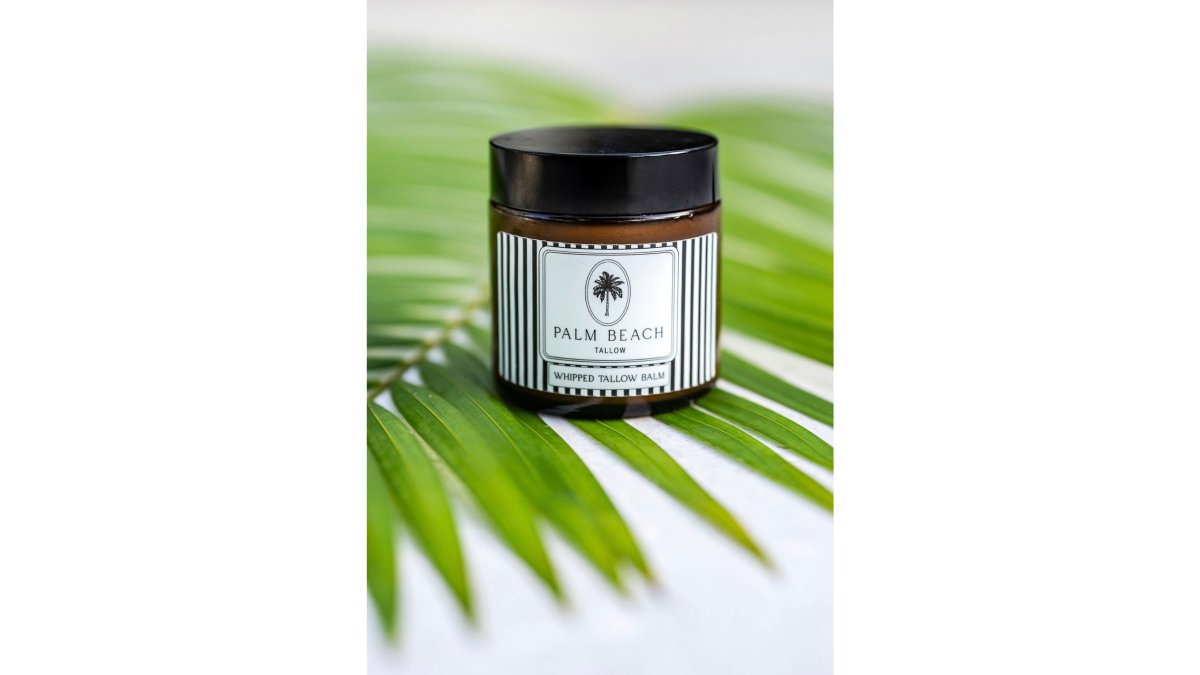
Our Whipped Tallow Balm is made with grass-fed and finished tallow, organic castor oil, organic olive oil, beeswax, and a note of sweet orange essential oil. The castor and olive oils make it spreadable and help it absorb without a heavy feel.
Fatty Acid Composition
Tallow is mostly a mix of saturated and monounsaturated fats, with smaller amounts of polyunsaturated fat. The dominant fatty acids in beef tallow are typically oleic acid (a monounsaturated fat), palmitic acid and stearic acid (saturated fats), plus smaller amounts of myristic and linoleic acid. Oleic acid is the same fatty acid that shows up in olive oil and is valued in skincare for its emollient feel. Stearic acid contributes to the firm, creamy texture of a balm. This profile is why tallow behaves like a rich, slow-absorbing moisturizer rather than a watery lotion.
The Fat-Soluble Vitamins
Tallow naturally carries small amounts of vitamins A, D, E, and K, which are the vitamins that dissolve in fat rather than water:
Why This Matters for the Skin Microbiome After UV Stress
Most after-sun guides ignore the skin microbiome, but it is worth a sentence here. UV exposure can disturb the community of bacteria and other organisms that live on the skin surface, and a disrupted barrier makes it easier for that community to shift. Tallow's occlusive and emollient properties support the barrier, which indirectly supports a healthier microbiome. That said, tallow is not a probiotic or a microbiome treatment, and no clinical studies establish a direct microbiome benefit from tallow balm. The honest framing is: a well-moisturized barrier is a better environment for the skin's natural flora than a dry, cracked one.
Evidence vs. Tradition
Tallow has been used in skincare for generations, and much of what is said about it rests on traditional use and on the known properties of its fatty acids and vitamins. Large clinical trials on tallow specifically for sunburn do not exist. The fatty acids and vitamins it contains are well studied in isolation, but that is not the same as a study of this balm on sunburned skin. Use it as a comfort and moisture step, not as a treatment for UV injury. Integrating this traditional approach alongside other natural sunburn remedies can provide a more comprehensive strategy for managing the discomfort associated with excessive sun exposure.
How to Soothe Sunburned Skin With Whipped Tallow Balm
The key is to cool the skin first, apply thin, and stop if anything stings. Below is a protocol organized by how the skin actually looks and feels, because a pink shoulder and peeling skin need different handling.
!Close-up of a woman's shoulder and upper arm after a day outdoors, a small scoop of pale whipped balm being smoothed onto slightly pink skin in soft natural window light

Step 1: Cool and Clean
Start with clean, cool skin, ideally after a cool shower or bath. Pat the skin gently dry with a soft towel, do not rub. Wait until the skin feels close to normal temperature to the touch before you apply anything.
Step 2: Match the Application to Burn Severity
Mild redness (pink, warm, tender, no blisters). This is the only category where balm is appropriate. Scoop a small amount, roughly a pea-sized amount per area the size of your palm, and smooth a thin layer over the skin. Use a light hand; more is not better. Reapply when the skin feels dry again, typically once or twice a day.
Heat-stressed but intact skin (feels hot and tight, may be slightly swollen). Cool first and give the skin time to settle. If you apply balm, use an even thinner layer than usual and watch for any feeling of trapped heat. If the skin feels warmer after application, remove it with a cool, damp cloth and wait.
Peeling skin. Once sunburned skin starts to peel, the barrier is already compromised and the peeling edge can be raw. Do not pick or peel the skin. If the newly exposed skin is raw or broken, treat it as an open wound and skip the balm.
Blisters, open wounds, swelling, or oozing. Do not apply balm. These are signs of a more serious burn that needs clean care and, often, medical attention. See the warning section below.
Step 3: Avoid the Wrong Areas
Keep balm away from the eye area and any broken skin. Do not apply it to the face if the burn is near the eyes, and do not use it on skin that is still actively blistering or weeping.
Step 4: Watch for Oxidation and Heat
Whipped tallow balm is an oil-based product, and oils are vulnerable to heat and light. If you keep a jar in a hot car, on a sunny windowsill, or in a beach bag all day, the oils can oxidize faster, which shows up as a change in smell, color, or texture. Store the balm somewhere cool and out of direct sunlight, and if it smells off or looks different, replace it. A balm that has been sitting in high heat is not the one to put on sun-stressed skin.
Step 5: Stop If It Stings
Stop use if irritation or stinging begins. A cooling sensation is normal; burning, itching, or worsening redness is not. If the skin reacts, rinse with cool water and let it rest.
What to Pair With It
For the first day or two after a mild burn, the most useful additions are cool compresses, plenty of water, and loose clothing over the area. Some people like to layer aloe vera gel under a thin balm layer for extra cooling; others prefer balm alone. If you want to combine tallow with a mineral sun protectant for future exposure, zinc oxide is the common active to look for, but that is prevention, not after-sun care.
The protocol depends on how the skin looks and feels, so match the application to the burn severity.
| Skin condition | Balm use | Reapply |
|---|---|---|
| Mild redness, no blisters | Pea-sized amount per palm-sized area, thin layer | Once or twice a day |
| Heat-stressed but intact | Even thinner layer; remove if warmer | Cool first, then as needed |
| Peeling skin | Do not pick or peel; skip if raw | Only if skin is intact |
| Blisters, open wounds, swelling, oozing | Do not apply balm | Seek care instead |
Tallow Balm for Sunburn: What It Can and Cannot Do
It cannot prevent sunburn, repair deep skin damage, or replace sun protection. For daily sun defense, you need a broad-spectrum sunscreen. If you want a sunscreen option that avoids a white cast, our Reef Safe Sunscreen No White Cast guide walks through what to look for.
Tallow Balm Side Effects and Who Should Be Careful
Reactions are possible, so check the ingredient list if you have allergies. Check the ingredient list if you have allergies to castor oil, olive oil, beeswax, or citrus oils.
Be especially careful if you:
- Have eczema, psoriasis, or another skin condition, and talk to a clinician first
- Are caring for a baby or young child, and do a patch test first
- Have very sensitive or reactive skin
Patch test a small area of skin for 24 hours before full use. Our Tallow Flare Ups Causes guide covers what tends to trigger reactions.
When to Seek Care for Sunburn Instead of Home Treatment
Seek medical care if a sunburn comes with fever, chills, headache, dizziness, nausea, or confusion. Also get help for burns covering large areas of the body, blistering burns, burns on the face or genitals, or burns that do not start to improve after a few days.
Children and older adults can be more at risk, so lower your threshold for calling a health care provider in those cases. Home care is for mild, uncomplicated sunburn only.
Starting Your After Sun Routine With Palm Beach Tallow's Whipped Tallow Balm
For a simple after-sun routine, apply a thin layer of our Whipped Tallow Balm to comfortable skin. It is made for everyday moisture on dry areas.
Our Grass-Fed Tallow Balm for Dry Skin is another option if you want a richer balm for hands, elbows, and rough patches.
Frequently Asked Questions
Can you put tallow balm on sunburn?
Many people apply a light moisturizer to sun-stressed skin once it has cooled, and whipped tallow balm is one option. It does not cool burning skin, repair deep tissue damage, or replace shade, a cool shower, and water. Apply a thin layer only to skin that is intact, not blistered, broken or weeping. If the skin is blistered or the burn is severe, skip the balm and seek medical care. Patch test first if your skin is reactive.
Can tallow balm make sunburn worse?
It can, in some situations. Heavy, occlusive layers applied to hot skin may trap heat, and any product can irritate skin that is already inflamed or broken. Avoid putting balm on blisters, open wounds, or areas with peeling skin that is weeping. Stop using the product if stinging, burning, itching or a rash develops. Tallow is a fat, so it is not a substitute for cooling and medical treatment when a burn is serious.
When should you seek medical care for a sunburn?
Seek care if the burn covers a large part of the body, blisters widely, or shows signs of infection such as spreading redness, swelling, pus, or fever. Get help quickly for burns on the face, eyes, genitals, or hands, and for anyone with a fever, chills, dizziness, or confusion. Infants under one year old with any sunburn should be seen by a doctor. People with diabetes, a weakened immune system, or who take medications that increase sun sensitivity should also contact a healthcare provider promptly.
Is whipped tallow balm safe for sensitive skin and kids?
Palm Beach Tallow's Whipped Tallow Balm is made with grass-fed and finished tallow, organic castor oil, organic olive oil, beeswax, and sweet orange essential oil, and the brand describes it as gentle enough for sensitive skin and the whole family. Sweet orange essential oil is a fragrance ingredient, so people with fragrance sensitivity should patch test first. Use it for external use only, avoid the eye area, and stop if irritation occurs. For a baby or a child with eczema, check with a pediatrician before using any new product on broken skin.
Whipped tallow balm can be a comforting part of your after-sun routine, especially for dry, irritated skin. It works best alongside sun protection and good judgment about when a burn needs professional care. Start with a patch test, use a thin layer, and stop if anything feels wrong.
