
Temple Tallow Alternative for Family Use: Top Picks
Table of Contents
- Why Families Look for a Temple Tallow Alternative
- Quick Comparison: Family Tallow Skincare Options
- Tallow Balm for Family Use: What to Look For
- Beef Tallow vs Coconut Oil for Face: Which Suits Your Family?
- Tallow Moisturizer for Sensitive Skin: Safety and Suitability
- How to Run a Tallow Skincare Patch Test
- Conclusion
- Frequently Asked Questions
Last Updated: October 12, 2026
Why Families Look for a Temple Tallow Alternative
Parents searching for a Temple Tallow alternative for family use usually start with the same frustration: they want one clean balm that works for a baby, a teenager, and themselves without a cabinet full of half-used jars. The problem is rarely the concept of tallow skincare. It is the fit.
Tallow is the rendered fat of beef or lamb, slowly heated to separate pure fat from tissue. Families move away from a single brand for practical reasons: a scent that irritates a child, a jar that runs out too fast, a formula built for one skin type, or a price that stops making sense once three people share it.
At Palm Beach Tallow, we hear these questions daily from mothers managing eczema, adults with psoriasis, and households trying to simplify. Below, we compare what actually matters for family use: ingredient lists, texture, sensitivity, and value per jar. The five criteria we cover decide whether one balm can genuinely serve everyone.
Quick Comparison: Family Tallow Skincare Options
Three products cover almost every family scenario, and each one fits a different need. The table below summarizes how they differ before we break down the details.
| Product | Price | Key Ingredients | Best For |
|---|---|---|---|
| Grass-Fed Tallow Balm for Dry Skin | $34.00 | Tallow, olive oil, beeswax, sweet orange oil | Face and body use on dry, tight skin |
| Tallow Balm for Dry Skin | $38.00 | Tallow, olive oil, beeswax, sweet orange oil | Rough patches, hands, heels, elbows |
| Tallow Sunscreen | $34.00 | Tallow, coconut oil, beeswax, non-nano zinc oxide | Outdoor days, reef-friendly protection |
For most families, the Grass-Fed Tallow Balm for Dry Skin is the starting point. It works as both a face and body balm, which means one jar replaces the separate lotion and facial moisturizer you are probably buying now. Households dealing with cracked heels and working hands tend to prefer the richer Tallow Balm for Dry Skin, while the Tallow Sunscreen covers the outdoor half of the routine.

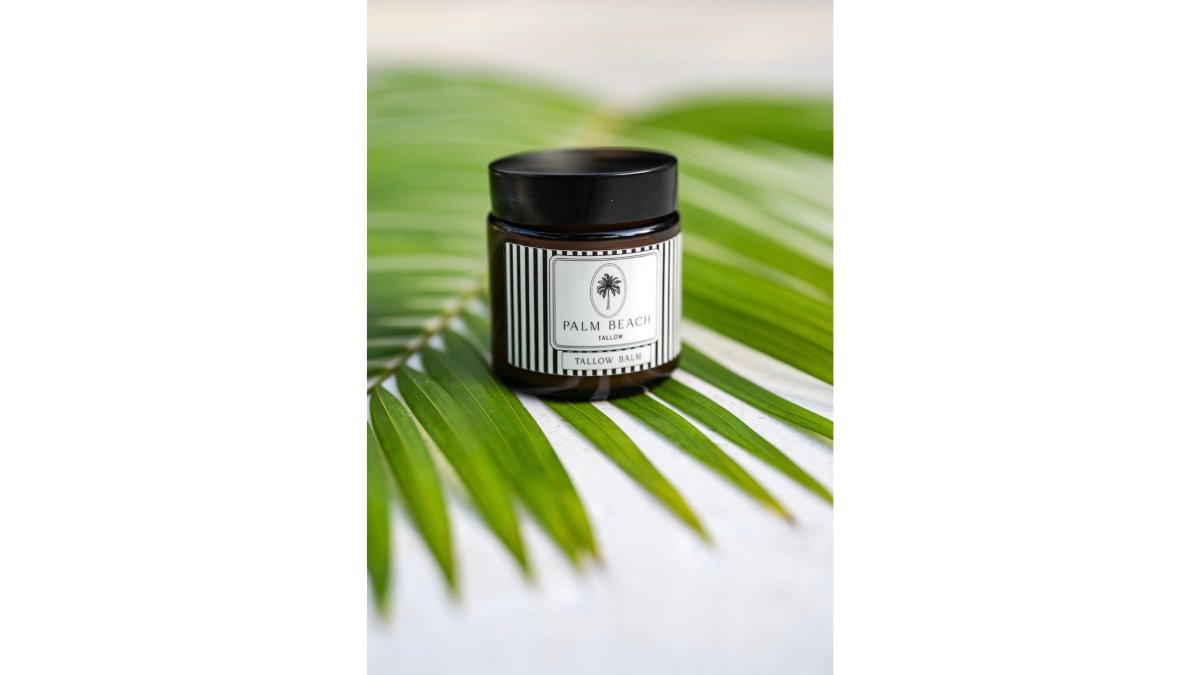
Tallow Balm for Family Use: What to Look For
A family-friendly tallow balm comes down to four things: a short ingredient list, a neutral or lightly scented formula, a texture that spreads without dragging, and a jar size that survives daily use by multiple people.

Start with the ingredient list. A tallow balm for family use should name every ingredient plainly. Palm Beach Tallow's balms use four: grass-fed and finished beef tallow, organic olive oil, beeswax, and organic sweet orange essential oil. When you can count the ingredients on one hand, you can also spot the one your child might react to.
Next, think about texture. Whipped balms spread easily and suit faces; denser balms hold up better on heels and elbows. Both types melt on contact, so a small amount goes far.
Then check the scent. Sweet orange is light, but any essential oil can bother a reactive child. Fragrance-free options matter here, and we will cover those in the sensitivity section.
Finally, consider how the product is stored and shared. A balm that lives in a shared bathroom needs clean hands, a closed lid, and a spot away from direct heat.
Beef Tallow vs Coconut Oil for Face: Which Suits Your Family?
Beef tallow and coconut oil both moisturize, but they behave differently on facial skin. Tallow's fatty acid profile closely resembles the lipids your skin already produces, which is why many people find it absorbs without a heavy residue. Coconut oil is occlusive and sits on the surface longer.
That difference matters most for acne-prone teenagers. Coconut oil is comedogenic for many people, meaning it can clog pores and trigger breakouts. Tallow is generally considered less likely to clog pores.
For dry, flaky skin, both work. For combination or acne-prone skin, tallow is usually the safer bet. For a baby's skin, the deciding factor is not the oil itself but everything else in the jar.
- Choose tallow for facial use, acne-prone teens, and skin that reacts to heavy oils
- Choose coconut oil for body use on very dry skin where absorption speed matters less
- Use both carefully if anyone in the family has a known sensitivity
The American Academy of Dermatology's guidance on moisturizers recommends fragrance-free, gentle products for sensitive and eczema-prone skin, which is worth keeping in mind when comparing any two oils.
Tallow Moisturizer for Sensitive Skin: Safety and Suitability
A tallow moisturizer for sensitive skin is often well tolerated because the base is short: rendered fat, a carrier oil, and a wax. Fewer ingredients means fewer places for a reaction to hide.
The most useful way to think about suitability is by age and skin condition, not by product claim.
Babies (under 12 months). Infant skin is thinner and more permeable than adult skin, and the barrier is still maturing. Most pediatric guidance favors plain, fragrance-free emollients and avoiding essential oils on infant skin.
Toddlers and young children. This is the age when eczema often first appears. A tallow balm can work as a barrier layer over damp skin after a bath, but it is not a substitute for a prescribed topical treatment during a flare.
Teenagers. Acne-prone teens are the family members most likely to react badly to a heavy balm. Tallow is generally considered less comedogenic than coconut oil. If a teen is using prescription acne medication, ask the prescriber before layering anything occlusive on top.
Adults with eczema or psoriasis. A tallow balm fits best as a barrier layer over damp skin, applied within a few minutes of bathing, and as a complement to, never a replacement for, prescribed treatment.
Adults with known allergies. Anyone with a diagnosed allergy to beef or dairy proteins should avoid tallow products and speak with a dermatologist before trying them.
Fragrance is the other variable families underestimate. "Natural" essential oils are still fragrance, and sweet orange, lavender, and peppermint are common triggers for reactive skin.
How to Run a Tallow Skincare Patch Test
A tallow skincare patch test takes three days and prevents most bad reactions. It also protects the jar itself, which matters when several people share one product. Here is the routine we suggest to families, plus the storage and hygiene habits that keep a shared balm usable.
Total time: about 10 minutes across 3 days.
- Day 1: Wash a small patch on the inner forearm and let it dry. Apply a pea-sized amount of balm and leave it for 24 hours.
- Day 2: Check the patch for redness, itching, or bumps. If clear, reapply and wait another 24 hours.
- Day 3: Check again. If the skin is calm, apply to a small area of the face or the area you actually want to treat.
- Watch for 48 hours after the first real use, especially on children and anyone with eczema or psoriasis.
- Stop immediately if you see swelling, spreading redness, or persistent itching, and contact a healthcare provider.
A few practical notes. Test one product at a time, not three at once, or you will not know what caused a reaction. Keep a note of the date and the product name. And if your child is already mid-flare, wait until the skin settles before testing anything new.
Testing more than one person from the same jar. This is where family use gets tricky. Do not dip fingers into a shared jar, that transfers skin cells, bacteria, and any allergen from one person to the next. Instead, scoop a small amount with a clean spoon or spatula onto a tissue or the back of a clean hand, then apply from there.
Storage and shelf life for a shared household balm. Heat, light, and dirty fingers will still degrade a balm over time. Keep the jar closed, store it below about 75°F and out of direct sun, and keep it out of the bathroom if your bathroom runs hot and steamy. A balm that smells rancid, turns grainy, or changes color has oxidized, throw it out rather than using it on a child.
A simple family routine. Keep one jar per person if anyone has reactive skin, or one shared jar with a dedicated scoop if everyone's skin is calm. Label the lid with the open date. Reassess every few months, because a product that worked for a toddler may not suit the same child two years later.
- Patch test completed on inner forearm
- 24 hours with no reaction
- 48 hours with no reaction
- First facial or target-area application done
- Product name and date recorded
- Dedicated scoop or spatula set aside for shared use
- Jar stored below 75°F, out of direct sun
- Open date written on the lid
Conclusion
Finding one balm that works for a baby, a teenager, and an adult with reactive skin is the real challenge, and it rarely comes down to a single "best" product. It comes down to a short ingredient list, an honest patch test, and a formula that suits the skin in front of you.
Palm Beach Tallow makes that choice simpler with hand-crafted balms built on grass-fed and finished tallow, organic olive oil, and beeswax. Our Grass-Fed Tallow Balm for Dry Skin covers face and body in one jar, our richer Tallow Balm for Dry Skin handles rough patches, and our Tallow Sunscreen adds reef-friendly, non-nano zinc protection for outdoor days. Every formula is made with simple, recognizable ingredients and safe for all ages.

Get started with Palm Beach Tallow and give your family one routine that works for everyone.
Frequently Asked Questions
What is a good substitute for beef tallow in skincare?
A tallow alternative can be another animal-derived fat, such as lamb tallow, or a plant-based option like prickly pear oil or a seed oil blend. When choosing for family use, look at the full ingredient list rather than the marketing name. Palm Beach Tallow's balms use grass-fed and finished beef tallow with organic olive oil and beeswax, so you can see exactly what is in the jar before it touches your child's skin.
Is a tallow moisturizer for sensitive skin safe for children?
Tallow balms are generally well tolerated, but sensitive skin still needs a patch test before full use. Apply a small amount to the inner forearm and wait 24 hours. Palm Beach Tallow's balm is made for face and body use with four simple ingredients, which limits the number of potential irritants. Stop use if redness, itching, or irritation appears.
How do you choose a tallow balm for family use?
Start with the ingredient list: fewer, recognizable ingredients are easier to screen for allergies. Check whether the balm is labeled for both face and body so one jar covers multiple family members. Compare price per use, not just the jar price, since a little balm goes a long way. A tallow skincare patch test on each family member before daily use is the final step.
Does tallow completely replace the need for a moisturizer?
A tallow balm works as a moisturizer on its own for most people, sealing in hydration. It does not replace sunscreen, and it does not treat diagnosed conditions like eczema or psoriasis without medical guidance. For daytime, apply balm first, then a reef-friendly sunscreen such as Palm Beach Tallow's non-nano zinc formula over it.
What's better for the face, coconut oil or beef tallow?
Both are occlusive fats that sit on top of the skin. Coconut oil is comedogenic for some users and can trigger breakouts on acne-prone skin. If your teenager has oily or acne-prone skin, a tallow balm is often the gentler starting point.