
Tallow Balm for Sensitive Skin: A Natural Alternative
Table of Contents
- Why Tallow Balm Works for Sensitive Skin
- Grass-Fed Tallow Balm for Eczema and Irritation
- Tallow vs Plant-Based Oils for Sensitive Skin
- Key Ingredients to Avoid and Why They Matter
- How to Patch Test Tallow Balm Before Full Use
- Using Tallow Balm on Face and Body for Optimal Results
- Conclusion: Making the Switch to Tallow for Your Family
- Frequently Asked Questions
Last Updated: September 26, 2026
Why Tallow Balm Works for Sensitive Skin
A tallow balm sensitive skin formula works because its fatty acid profile mirrors human sebum, allowing your skin to recognize and absorb it without triggering inflammation from synthetic ingredients.

Grass-fed tallow contains fat-soluble vitamins (A, D, E, and K) that support barrier repair and skin cell regeneration, delivering nutrients your skin needs to heal itself.
Grass-Fed Tallow Balm for Eczema and Irritation
A grass-fed tallow balm for eczema creates an occlusive barrier that reduces transepidermal water loss, the primary driver of eczema flares, by sealing hydration into the skin barrier.

Vitamin A reduces inflammation and supports skin cell turnover, vitamin D regulates immune response, and vitamin E protects against oxidative stress, all critical for eczema sufferers.
Tallow softens rough, cracked skin without the irritation that some plant oils like coconut oil cause, because it matches your skin's natural lipid composition.
Many people with eczema find that switching to a tallow balm reduces their need for topical steroids. Consult your healthcare provider before changing treatment. Apply to damp skin right after bathing to lock in moisture.
Tallow vs Plant-Based Oils for Sensitive Skin
Plant oils like jojoba, argan, and rosehip are excellent moisturizers, but tallow matches your skin's sebum composition so closely that absorption happens more efficiently.
Plant oils can trigger sensitivity in compromised barriers and oxidize over time, creating free radicals that worsen inflammation. Tallow is more stable and doesn't oxidize as readily.
Tallow absorbs more completely than plant oils because your skin recognizes it as familiar, delivering deeper hydration with less surface residue, an advantage for eczema and rosacea.
| Characteristic | Tallow Balm | Plant-Based Oils |
|---|---|---|
| Absorption Rate | Fast (matches skin lipids) | Slower (foreign to skin composition) |
| Oxidation Risk | Low (stable fat) | Higher (prone to breakdown) |
| Barrier Compatibility | Excellent (mimics sebum) | Good (but not identical) |
| Irritation Potential | Very Low | Moderate (varies by oil type) |
| Vitamin Profile | A, D, E, K (fat-soluble) | Varies (often water-soluble) |
Key Ingredients to Avoid and Why They Matter
Understanding why certain ingredients trigger reactions helps explain how tallow-based formulas avoid these pitfalls.
Synthetic fragrances and masking agents: Fragrance is the #1 contact allergen in skincare and can cause immediate irritation or delayed hypersensitivity reactions. Look for "unscented" products or those listing essential oils by name. Tallow-based formulas avoid this by relying on natural scent and low-concentration essential oils, allowing your skin to focus on barrier repair.
Preservatives (parabens, phenoxyethanol, methylisothiazolinone): These disrupt the skin microbiome and trigger immune responses in sensitive individuals. Tallow balms use beeswax as a natural preservative with antimicrobial properties that don't disrupt the microbiome.
Sulfates (sodium lauryl sulfate, sodium laureth sulfate): These strip away natural oils and are common triggers for eczema flares. Use a gentle, sulfate-free cleanser with your tallow balm to avoid undoing barrier-repair work.
Alcohol (especially denatured alcohol): Denatured alcohol disrupts the skin barrier's lipid matrix and spikes transepidermal water loss, making it counterproductive for sensitive skin.
Essential oils at high concentrations: Essential oils like lavender, tea tree, and eucalyptus can irritate sensitive skin. Tallow balms use them at 1-2% concentration for mild aromatherapy without triggering reactions.
Silicones (dimethicone, cyclopentasiloxane): These trap bacteria and sweat, worsening acne and rosacea, and interfere with natural moisture regulation in compromised barriers.
The ingredient interaction advantage of tallow-based formulas: Tallow provides lipid matrix and fat-soluble vitamins (A, D, E, K). Beeswax adds occlusion and antimicrobial protection. Organic olive oil contributes emollients and polyphenol antioxidants. For eczema, this combination reduces inflammation and transepidermal water loss.
The safest approach is the shortest ingredient list. Fewer ingredients mean fewer potential triggers. A tallow balm with grass-fed tallow, organic olive oil, beeswax, and optional essential oils contains nothing synthetic or inflammatory.
How to Patch Test Tallow Balm Before Full Use
A proper patch test takes 24-72 hours and reveals whether your skin will tolerate the product before full application.
Step 1: Choose a test location. The inner forearm or behind the ear are ideal because the skin there is thin and sensitive, mimicking facial skin reactivity, but less visible if irritation occurs. Avoid areas you've recently shaved, waxed, or treated with other actives (retinoids, acids, vitamin C). If you're testing for body use, test on the inner arm rather than the face, since body skin is often less reactive.
Step 2: Cleanse the test area. Use only water or a gentle, fragrance-free cleanser. Pat dry and wait 30 minutes before applying the tallow balm to ensure your skin barrier has stabilized.
Step 3: Apply a minimal amount. Use roughly the size of a grain of rice. Rub it in gently and let it dry naturally without covering the area; your skin needs air exposure to show a true reaction.
Step 4: Monitor for 24-72 hours. Don't wash the area, don't apply other products, and resist the urge to touch or scratch it. Keep a log of what you observe:
- Hour 0-2: Immediate reactions (burning, stinging, visible redness) suggest a contact irritant reaction, which is less common with tallow but possible if you're sensitive to beeswax or olive oil.
- Hour 2-24: Delayed irritation (itching, swelling, hives) indicates a possible allergic response. This is the most common timeframe for tallow sensitivity to appear.
- Hour 24-72: Very delayed reactions (eczema flare, widespread redness) suggest your skin barrier is reacting to the product's occlusive properties or one of its components is triggering systemic inflammation.
Step 5: Assess the results. If you see no redness, itching, burning, swelling, or texture changes, the tallow balm is likely safe for you. Mild warmth or a slight sheen is normal and not a sign of irritation. If you notice any reaction, photograph it and wait until it fully resolves before trying anything else, typically 3-7 days depending on severity.
Common patch test mistakes:
- Testing on already-inflamed skin: If you have active eczema or a rash, patch testing will be unreliable. Wait until your skin has calmed for at least 48 hours.
- Testing multiple products simultaneously: If you patch test tallow balm and a new cleanser at the same time, you won't know which product caused a reaction. Test one product per week.
- Stopping the test too early: Reactions can appear 48-72 hours in. Stopping at 24 hours may miss delayed hypersensitivity.
- Using too much product: Overloading the test site can trigger irritation from occlusion alone, not from the product's ingredients. Stick to the grain-of-rice amount.
After a successful patch test: Once you've confirmed tolerance on a small area, you can introduce the tallow balm to your entire face or body. Start with the smallest recommended amount (pea-sized for face) and apply once daily for the first week. If no irritation develops, you can increase to twice-daily application or larger amounts as needed.
This process prevents the frustration of a full-face reaction and gives you confidence that the product will work for your skin. Many people skip this step and regret it; taking three days to test saves weeks of dealing with a flare.
Using Tallow Balm on Face and Body for Optimal Results
Application technique matters as much as the product itself. For facial use, apply tallow balm to damp skin, either right after cleansing or after misting your face with water. Damp skin allows the balm to spread more evenly and absorb more completely. Use your fingertips to warm the balm slightly, then press it gently into the skin rather than rubbing.
The amount is critical. For your entire face, you need roughly a pea-sized amount.
Conclusion: Making the Switch to Tallow for Your Family
If your family has struggled with conventional moisturizers triggering reactions, switching to a tallow balm sensitive skin option represents a meaningful shift toward ingredient simplicity and skin compatibility. The barrier-repair benefits, vitamin density, and natural lipid profile make it a rational choice for sensitive skin, not a trend, but a return to what actually works.
Frequently Asked Questions
What makes grass-fed tallow balm different from regular moisturizers for sensitive skin?
Grass-fed tallow balm mimics your skin's natural sebum composition, allowing it to absorb deeply without clogging pores. Its fatty acid profile, rich in vitamins A, D, E, and K, supports skin barrier repair and reduces transepidermal water loss. Unlike synthetic moisturizers, tallow is bioavailable, meaning your skin recognizes and uses it efficiently. This alignment with your skin's biology makes it gentler for sensitive conditions like eczema and psoriasis.
Is grass-fed tallow safe for facial use on sensitive skin?
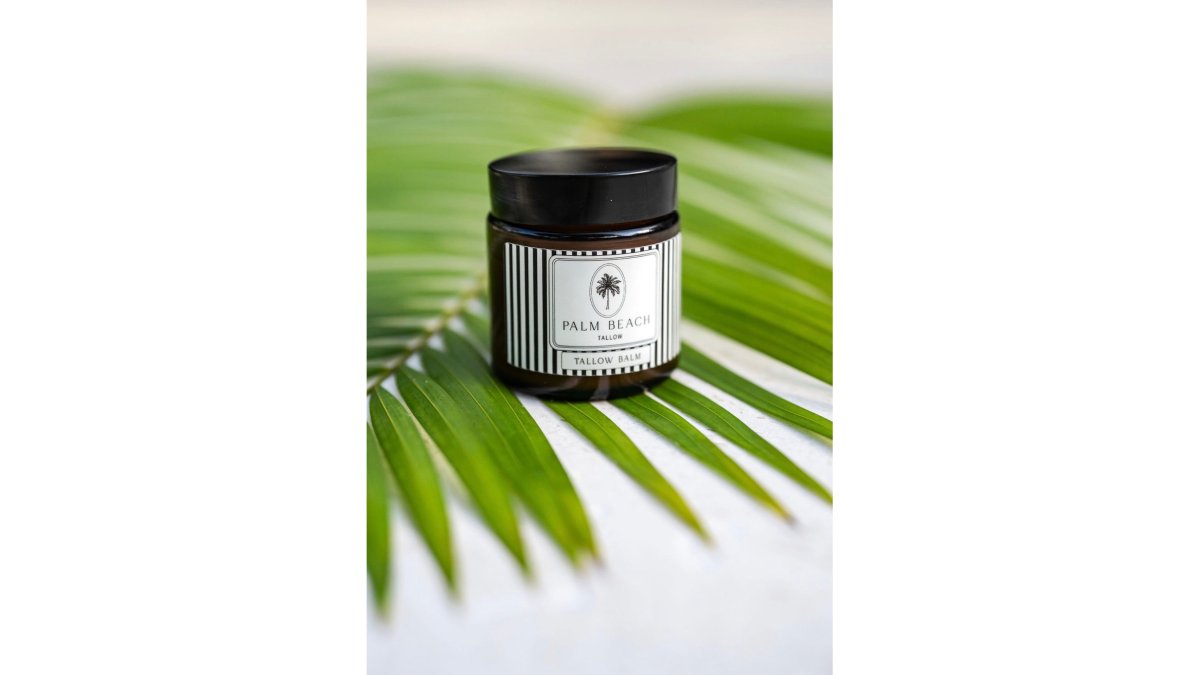
Yes, grass-fed tallow is safe for facial use on sensitive skin when sourced from reputable, clean suppliers. Tallow is non-comedogenic, meaning it won't clog pores, and it's hypoallergenic when free from synthetic additives. Products like Palm Beach Tallow's balm are formulated without essential oils in the unscented version, making them suitable for those with dermatological sensitivity. Always patch test first to confirm your skin tolerates it.
How does tallow balm compare to traditional moisturizers for eczema?
Tallow balm acts as both an emollient and an occlusive. It softens skin while creating a breathable protective barrier that seals in hydration. Tallow's rich lipid profile reduces inflammation, addressing the root cause of eczema flare-ups rather than masking symptoms.
What should I do if I have a bad reaction to tallow balm?
Stop use immediately and rinse the affected area with cool water. Switch to an unscented formula if you reacted to fragrance. If irritation persists beyond 24 hours or you experience severe redness, contact a dermatologist.