
Grass-Fed Tallow for Eczema: What Works and What Doesn't
Table of Contents
- What Grass-Fed Tallow Is and How It Works on Eczema-Prone Skin
- Fatty Acids and Fat-Soluble Vitamins That Support Skin Barrier Repair
- How to Patch Test Skincare Before Using Tallow on Sensitive Skin
- Tallow Balm for Eczema: Application and Moisturizing Dry, Itchy Skin
- Tallow vs. Coconut Oil for Eczema: Which Moisturizer Is Right for You
- Using Tallow for Children's Eczema: Safety and Age-Appropriate Application
- When to Stop Using Tallow and Seek Medical Care for Eczema Flare-Ups
- Choosing Quality Tallow Balm: Reading Labels and Evaluating Ingredients
- Frequently Asked Questions
Last Updated: October 5, 2026
What Grass-Fed Tallow Is and How It Works on Eczema-Prone Skin
Grass-fed tallow is rendered beef fat from pasture-raised cattle. Used for centuries in traditional skincare, it closely mirrors the lipids in human skin, so applying grass-fed tallow eczema treatment adds back fats the barrier may be missing.
Eczema damages the skin barrier, which normally locks in moisture and keeps irritants out. When it breaks down, skin loses water fast and becomes dry, itchy, and inflamed. Tallow fills those gaps with fatty acids and fat-soluble vitamins your skin recognizes and absorbs.
Here's what happens when you use it:
- The tallow melts at body temperature and spreads easily
- Fatty acids penetrate the outer skin layer
- Vitamins A, D, E, and K support barrier repair
- Moisture stays locked in longer than with water-based lotions
Grass-fed tallow is richer in omega-3 fatty acids and fat-soluble vitamins than grain-fed. That matters for eczema-prone skin because those nutrients support skin cell regeneration and reduce inflammation.
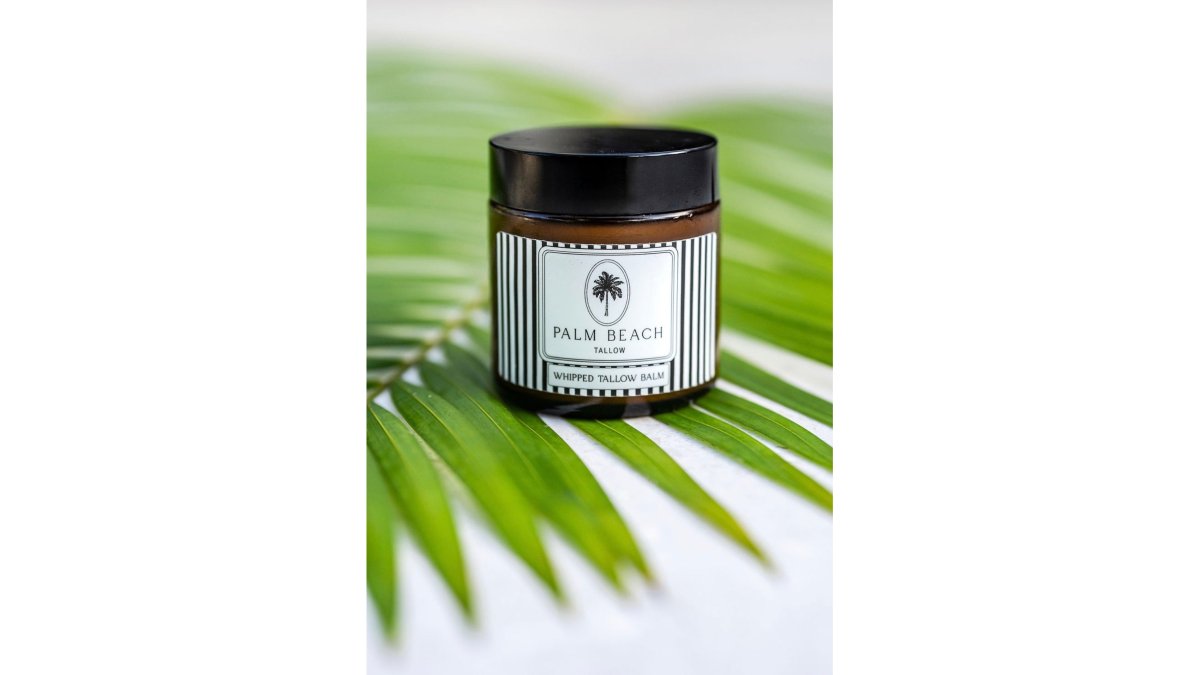
At Palm Beach Tallow, we use grass-fed and finished beef tallow specifically because the nutrient density makes a real difference. Our Grass-Fed Tallow Balm is a rich, simple moisturizer for your face and body, made with grass-fed and finished beef tallow, organic olive oil, beeswax, and organic sweet orange essential oil.

Fatty Acids and Fat-Soluble Vitamins That Support Skin Barrier Repair
Your skin barrier relies on specific fats, and eczema flares deplete them. Grass-fed tallow restores the barrier with the exact fatty acids your skin needs.
Oleic acid is tallow's dominant fatty acid. This omega-9 fat penetrates deeply and reduces water loss, helping restore the lipid layer that holds moisture in.
Palmitic acid and stearic acid are saturated fats that firm up the skin barrier and prevent moisture from escaping. Together, these three fatty acids create a protective seal that water-based moisturizers simply can't match.
The fat-soluble vitamins are equally important:
- Vitamin A supports skin cell turnover and reduces inflammation
- Vitamin D helps regulate immune response in the skin and calms inflammatory signals
- Vitamin E is a powerful antioxidant that protects skin from oxidative stress during flare-ups
- Vitamin K supports skin healing and may reduce redness and irritation
Grass-fed tallow contains all four in bioavailable forms your skin can actually use, unlike synthetic vitamins in some skincare products.
As eczema-prone skin absorbs these nutrients, the barrier repairs. Unlike petroleum-based moisturizers, tallow doesn't just sit on top of skin, it feeds it.
How to Patch Test Skincare Before Using Tallow on Sensitive Skin
Even natural products can trigger reactions in sensitive skin. A patch test shows whether tallow will calm your eczema or worsen it before you apply it all over.
What you'll do:
-
Pick a small, hidden area. The inside of your forearm or behind your ear works best. Avoid areas with active eczema or open skin.
-
Apply a pea-sized amount. Warm the tallow between your fingertips and smooth it onto clean, dry skin.
-
Leave it for 24 hours. Don't wash it off. Let your skin react naturally.
-
Check for redness, itching, or swelling. If your skin feels calm or better, you're likely safe to use it. If itching increases or a rash appears, stop immediately.
-
Wait 48 hours before full application. Even if the patch test passes, introduce tallow slowly. Use it once daily for three days, then increase frequency.
Eczema-prone skin can react to ingredients that don't bother others. Tallow is generally gentle, but sensitivities vary, and a one-day patch test prevents a full-body flare-up.
Common reactions to watch for include itching that worsens within hours, visible rash, burning sensation, or swelling. These signal your skin isn't ready for this product. Stop use and consult a dermatologist if reactions persist.
Tallow Balm for Eczema: Application and Moisturizing Dry, Itchy Skin
How you apply tallow balm determines how well it works. Most people use too much and end up greasy, but a little goes a long way.
How to apply tallow balm:
- Use a pea-sized amount for your face, an almond-sized amount for arms or legs
- Warm it between your fingertips until it softens
- Smooth it onto clean, slightly damp skin
- Focus on the driest, most irritated areas
- Let it absorb for 5-10 minutes before dressing
Apply right after bathing, when skin is warm and slightly moist, so the tallow penetrates. On completely dry skin it sits on the surface longer.
For severe dryness or flare-ups, apply twice daily; during calm periods, once daily is usually enough. If itching returns by evening, add a second application.
For different body areas:
On your face, use the smallest amount, since facial skin is thinner and the balm spreads further than expected.
For children, apply the same way with even less product, focusing on typical flare areas: face, hands, elbows, and behind the knees.
At Palm Beach Tallow, our Whipped Tallow Balm has a smooth texture.

Tallow vs. Coconut Oil for Eczema: Which Moisturizer Is Right for You
Both are popular natural moisturizers, but they work very differently on eczema-prone skin.
Coconut oil is lighter, absorbs faster, and feels less greasy, but it's comedogenic and high in lauric acid, which can trigger inflammation in eczema-prone skin. Many dermatologists recommend avoiding it for eczema.
Grass-fed tallow is heavier and slower to absorb but matches your skin's lipid structure more closely. It doesn't clog pores, its fatty acids reduce rather than trigger inflammation, and as a single-source ingredient it's less likely to cause allergic reactions.
The practical difference: coconut oil feels better initially but creates no lasting barrier. Tallow absorbs slower.
For children with eczema, tallow is safer: coconut oil's potential to increase inflammation makes it risky during flare-ups, while tallow's nutrients actively support healing.
Grass-Fed Tallow Balm for Dry Skin →
| Moisturizer | Absorption Speed | Barrier Support | Inflammation Risk | Best For |
|---|---|---|---|---|
| Coconut Oil | Fast (30 min) | Weak | High (lauric acid) | Non-eczema dry skin |
| Grass-Fed Tallow | Slow (2-4 hours) | Strong | Low | Eczema-prone skin |
| Water-Based Lotion | Very fast (10 min) | Very weak | Low | Mild dryness only |
If coconut oil worsened your eczema, that's not unusual. Switch to tallow for two weeks.
Using Tallow for Children's Eczema: Safety and Age-Appropriate Application
Tallow is safe for children of all ages, including infants. It's a single-source ingredient with no harsh chemicals, preservatives, or fragrances to irritate developing skin.
For infants (under 12 months):
Use plain tallow without added essential oils. Newborn skin is extremely delicate. Apply sparingly to dry patches only, not all over.
For toddlers (1-3 years):
Childhood eczema often appears now, and tallow suits toddlers who can't tolerate many products.
For school-age children (4-12 years):
Kids this age can use tallow twice daily if needed. Involve them in the routine to build good habits; eczema often improves with consistent moisture as skin matures.
For teenagers:
Teens may resist heavy moisturizers, so whipped tallow balm feels lighter and less greasy than solid. Consistency matters more than quantity at this age.
A common concern is acne in teenagers.
Never force a product a child hates.
When to Stop Using Tallow and Seek Medical Care for Eczema Flare-Ups
Tallow is a moisturizer, not an eczema treatment. It supports barrier health and can reduce flare-ups but can't cure eczema, so know when to call a doctor.
Stop using tallow and seek care if:
- Itching gets worse instead of better after two weeks
- Your skin develops signs of infection (warmth, pus, crusting, swelling)
- A flare-up spreads to your face, hands, or other sensitive areas
- Your child develops a fever along with a skin flare-up
- You develop hives or signs of an allergic reaction
These need professional evaluation. A dermatologist can prescribe topical steroids or other treatments tallow cannot replace.
When tallow is enough:
Mild eczema that responds to consistent moisture usually improves with tallow alone. If skin stays calm for months, you're managing it well.
Moderate eczema often needs tallow plus a prescription treatment: use tallow as your daily moisturizer and prescribed creams during flare-ups.
Severe eczema requires medical care. Tallow can support treatment but won't control severe inflammation on its own.
Choosing Quality Tallow Balm: Reading Labels and Evaluating Ingredients
Not all tallow balms are equal. The source and processing determine quality and effectiveness.
What to look for on the label:
- Grass-fed and finished beef. This means the cattle ate grass for their entire lives. Grass-fed tallow has higher nutrient density than grain-fed.
- No added fragrance or essential oils if you have sensitive skin. Natural fragrance is nice, but it adds irritation risk. Plain tallow is safest for eczema-prone skin.
- Simple ingredient lists. Tallow, beeswax, and one or two oils. That's it. Avoid products with more than five ingredients.
- No preservatives or emulsifiers. These extend shelf life but can irritate sensitive skin.
- Organic olive oil or similar. If oil is added, it should be cold-pressed and organic.
Check the sourcing information: where the cattle came from and how the tallow was rendered. Palm Beach Tallow provides full sourcing details because quality matters.
Red flags to avoid:
- Tallow from grain-fed cattle (lower nutrient profile)
- Products with fragrance listed as "natural fragrance" without specifics
- Long ingredient lists with unfamiliar names
- No information about sourcing or processing
- Prices suspiciously low (suggests lower-quality tallow)
Read reviews, but remember they're subjective: one person's "too greasy" is another's "finally moisturizing enough." Look for patterns, since repeated complaints are meaningful.
According to FDA guidance on cosmetic ingredients, tallow is recognized as safe for topical use. This doesn't mean all tallow products are equal in quality. Regulation focuses on safety, not effectiveness.
Ask yourself these questions before buying:
- Can I find information about where the cattle came from?
- Are the ingredients simple and recognizable?
- Does the company explain their sourcing and processing?
- Have other people with eczema reported good results?
Quality tallow costs more than drugstore moisturizers, and that's normal: better nutrient density, sourcing, and consistency are what you're paying for.
Eczema-prone skin needs a moisturizer that supports barrier repair, not one that just sits on the surface.
Frequently Asked Questions
How do you patch test tallow balm before using it on eczema?
Apply a small amount of tallow balm to a discreet area like the inner elbow or behind the ear. Wait 24-48 hours and observe for redness, itching, or irritation. If no reaction occurs, gradually introduce it to larger areas. Start with minimal amounts on affected skin, since even gentle products can trigger sensitivity in some people with eczema-prone skin. Discontinue immediately if irritation develops.
Can grass-fed tallow irritate eczema-prone skin?
While grass-fed tallow is generally well-tolerated, individual reactions vary. Some people with sensitive skin may react to the balm itself or specific ingredients like sweet orange essential oil. This is why patch testing is essential. If you experience increased redness, itching, or flare-ups after using tallow balm, stop use and consult a dermatologist. Quality matters: choose tallow products with minimal, recognizable ingredients and no harsh additives.
Is tallow balm safe for children's eczema?
Tallow balm made with simple, clean ingredients can be safe for children when used correctly. Always patch test first, even on young skin. For older children, apply tallow balm to damp skin after bathing to lock in moisture. Avoid the eye area and discontinue use if irritation occurs. Monitor closely during the first week of use.
What makes grass-fed tallow different from coconut oil for treating eczema?
Grass-fed tallow contains fat-soluble vitamins A, D, E, and K, plus fatty acids that closely mimic skin's natural lipid barrier. Coconut oil, while moisturizing, is higher in lauric acid, which can be comedogenic and may trigger sensitivity in some people with eczema. Tallow's nutrient profile and barrier-supporting structure make it gentler for many eczema-prone individuals. However, personal tolerance varies; patch test both to see which works better for your skin.